Reference tissue compartmental models
The reference tissue compartmental model is an alternative method for the estimation of binding potential (BP) from reversible ligand-receptor studies. This model does not require or use plasma samples, but instead a reference region with low or non-existent specific binding.
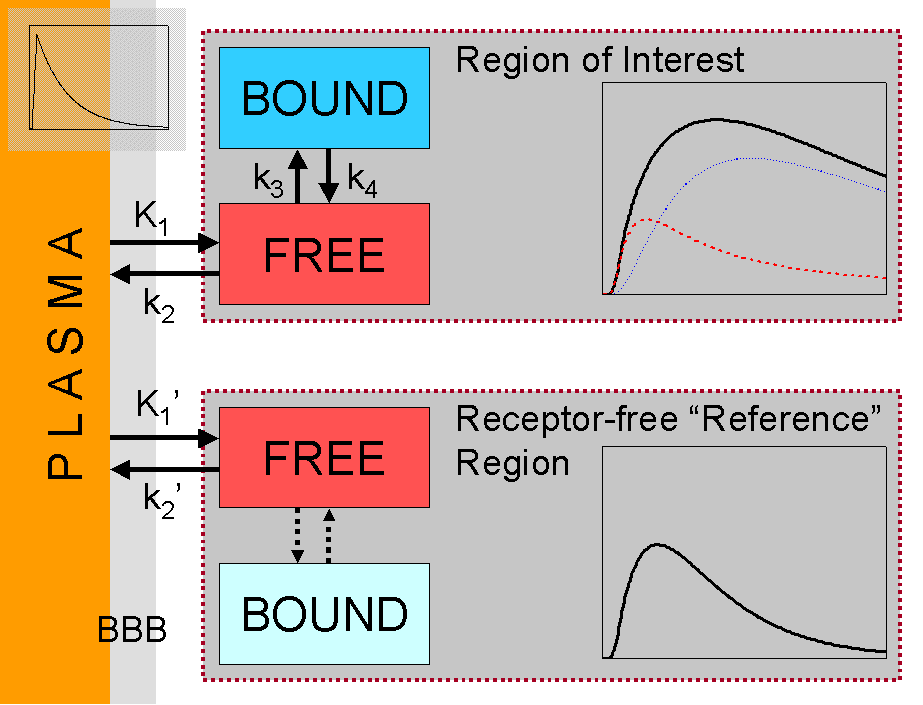
The parameters R1 (ratio of the K1 values of regions of interest and reference tissue), k2, k3, and BP (k3/k4) can be estimated using nonlinear fitting [Cunningham et al 1991]. This model has some advantages over the Logan plot: dynamic study can be used from the beginning with no need to wait for any equilibrium or search for linear phase. Reference tissue model also provides an estimate for the perfusion and transport of tracer to the tissue (R1).
If the binding is irreversible, the model can be reduced by setting k4=0. Then the k3 value provided by the model will be proportional to the concentration of unoccupied receptors [Wong et al. 1986].
Simplified reference tissue model can be used when two compartmental model could reasonable describe the kinetics of the tracer in tissue [Lammertsma and Hume 1996]. The parameters of simplified model (R1, k2 ja BP) can be solved not only using nonlinear fitting but also using linearized methods [Blomqvist 1984], or with a bit more complicated methods [Gunn et al. 1997]. This makes it possible to produce parametric images of model parameters, and, when linearized, also to do the calculations at the sinogram level.
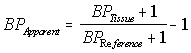
If the reference region has specific binding, the BP will be underestimated [Gunn et al. 1997]: