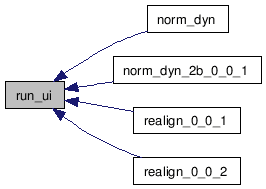
Go to the source code of this file.
| realign_0_0_1 | ( | opt | ) |
Within Mode Image Realignment
Modified for Turku PET Centre
version 0.0.1,26-04-2007,Harri Merisaari added reference frame selection
___________________________________________________________________________
This routine realigns a time-series of images acquired from the same subject
using a least squares approach and a 6 parameter (rigid body) spatial
transformation. The first image in the list specified by the user is used
as a reference to which all subsequent scans are realigned. The reference
scan does not have to the the first chronologically and it may be wise to
chose a 'representative scan' in this role.
For fMRI data an additional adjustment is made to the data that removes
a tiny amount of the movement-related confounds of these effects.
However, it may be preferable to include the functions of the estimated
movement parameters as confounds in the statistics part.
Uses
Primarily to remove movement artefact in fMRI and PET time-series (or more
generally longitudinal studies)
Inputs
A series of *.img conforming to SPM data format (see 'Data Format'). The
relative displacement of the images should be small with respect to their
resolution. This is usually easy to ensure for functional images (e.g.
fMRI, PET SPECT).
Outputs
The parameter estimation part writes out ".mat" files for each of the
input images. The part of the routine that writes the resliced images
uses information in these ".mat" files and writes the realigned *.img
files to the same subdirectory prefixed with an 'r' (i.e. r*.img). The
details of the transformation are displayed in the results window as
plots of translation and rotation.
A set of realignment parameters are saved for each session, named:
realignment_params_*.txt.
__________________________________________________________________________
Refs:
Friston KJ, Ashburner J, Frith CD, Poline J-B, Heather JD & Frackowiak
RSJ (1995) Spatial registration and normalization of images Hum. Brain
Map. 2:165-189
Friston KJ, Williams SR, Howard R Frackowiak RSJ and Turner R (1995)
Movement-related effect in fMRI time-series. Mag. Res. Med. 35:346-355
W. F. Eddy, M. Fitzgerald and D. C. Noll (1996) Improved Image
Registration by Using Fourier Interpolation. Mag. Res. Med. 36(6):923-931
R. W. Cox and A. Jesmanowicz (1999) Real-Time 3D Image Registration
for Functional MRI. Submitted to MRM (April 1999) and avaliable from:
http://varda.biophysics.mcw.edu/~cox/index.html.
_______________________________________________________________________
In addition to realigning (transforming the images according to a rigid
body model) the time series there is the option of modelling the residual
movement related variance in an EPI (fMRI) time series that can be
explained by a model for suceptibility-by-movement interactions. This
is given by the "Realign & Unwarp" option.
Susceptibility artefacts in EPI time series is a consequence of the
"field disturbances" caused by the presence of an object in the field.
Susceptibility is a property of a material, and can be thought of as
the "resistance" put up by that material against being magnetised.
At the interface between materials with different susceptibility
rather severe field disturbancies will ensue. I.e. the field is
no longer nice and homogenous. Since varying field strenght (gradients)
is used to encode position in MRI, these disturbances cause spatial
misplacement of RF signal, i.e. geometric distortions. Because of
the low bandwidth in the phase encode direction these distortions
will be appreciable mainly in that direction (typically the Ant-Post
direction). The distortions are noticable mainly near air-tissue
interfaces inside the scull, i.e. near the sinuses and the auditory
canals.
In these areas in particular the observed image is a severly warped
version of reality, much like a funny mirror at a fair ground. When
one moves in front of such a mirror ones image will distort in
different ways and ones head may change from very elongated to
seriously flattened. If we were to take digital snapshots of the
reflection at these different positions it is rather obvious that
realignment alone will not suffice to bring them into a common space.
The situation is similar with EPI images, and an image collected
for a given subject position will not be identical to that collected
at another. We call this effect suscebtibility-by-movement interaction.
The "Unwarp" toolbox is predicated on the assumption that the
suscebtibility-by-movement interaction is responsible for a sizeable
part of residual movement related variance.
Assume that we know how the deformations change when the subject changes
position (i.e. we know the derivatives of the deformations with respect
to subject position). That means that for a given time series and a
given set of subject movements we should be able to predict the "shape
changes" in the object and the ensuing variance in the time series.
It also means that, in principle, we should be able to formulate the
inverse problem, i.e. given the observed variance (after realignment)
and known (estimated) movements we should be able to estimate how
deformations change with subject movement.
We have made an attempt at formulating such an inverse model, and at
solving for the "derivative fields". A deformation field can be thought
of as little vectors at each position in space showing how that particular
location has been deflected. A "derivative field" is then the rate of
change of those vectors with respect to subject movement. Given these
"derivative fields" we should be able to remove the variance caused by
the suscebtibility-by-movement interaction. Since the underlying model
is so restricted we would also expect experimentally induced variance
to be preserved.
Refs
Background reading:
Friston KJ, Williams SR, Howard R, Frackowiak RSJ and Turner R (1995)
Movement-related effect in fMRI time-series. Mag. Res. Med. 35:346-355
Jezzard P and Balaban RS (1995) Correction for geometric distortions
in echoplanar images from B0 field variations. Magn Reson Med 34:65-73
Wu DH, Lewin JS and Duerk JL (1997) Inadequacy of motion correction
algorithms in functional MRI: Role of susceptibility-induced artefacts.
J Magn Reson Imag 7:365-370
About this particular method:
Andersson JLR, Hutton C, Ashburner J, Turner R, Friston K (2001)
Modelling geometric deformations in EPI time series. NeuroImage
13:903-919. doi:10.1006/nimg.2001.0746
_______________________________________________________________________
The Prompts Explained
_______________________________________________________________________
'Number of subjects'
Enter the number of subjects you wish to realign.
For fMRI, it will ask you the number of sessions for each subject.
In the coregistration step, the sessions are first realigned to
each other, by aligning the first scan from each session to the
first scan of the first session. Then the images within each session
are aligned to the first image of the session.
The parameter estimation is performed this way because it is assumed
(rightly or not) that there may be systematic differences
in the images between sessions.
The adjustment step (correcting for resampling artifacts) is also
performed completely independantly between each of the fMRI sessions.
'Images, subject # ..'
Select the scans you wish to realign. All operations are relative
to the first image selected.
......... Note that not all of the following prompts may be used: .........
'Which option?'
'Coregister only'
Only determine the parameters required to transform each of the
images 2..n to the same space as image 1.
The determined parameters for image XXXX.img are saved in the
file XXXX.mat. This is a Matlab file, containing the matrix 'M'.
The location of an image voxel (in mm) can be determined by
computing M(1:3,:)*[xcoord ycoord zcoord 1].
Note that if the coregistration is performed more than once on
the unresliced data, the starting estimates are obtained from
parameters stored in the '.mat' files.
Note that for PET, the coregistration is a two step process.
First of all, the images are all realigned to the first in
the series. A mean of these realigned images is created, and
a second pass realignment is performed to realign all the
images to the mean. Finally, the parameters are corrected
for any differences estimated by registering the first image in
the series to the mean image.
'Reslice Only'
Reslice the specified images according to the contents of the
previously determined parameters. The images are resliced to be
in the same space as the first one selected. For fMRI, this is
the first image of the first session.
'Coregister & Reslice'
Combine the above two steps together.
Options for reference image:
'Select reference frame(s)'
'1st frame (dafault)'
This uses 1st frame as reference image
'Select reference frame numbers'
This uses user selected frames from input for creating reference images
'Select reference frame image'
This uses user selected image for reference image
Options for reslicing:
'Create what?'
'All Images (1..n)'
This reslices all the images - including the first image selected
- reference frame will stay it soriginal position
'Images 2..n'
Reslices images 2..n only. Useful for if you wish to reslice
(for example) a PET image to fit a structural MRI, without
creating a second identical MRI volume.
'All Images + Mean Image'
In addition to reslicing the images, it also creates a mean of the
resliced image.
'Mean Image Only'
Creates the mean image only.
_______________________________________________________________________
Defaults Options
_______________________________________________________________________
'Registration Quality?'
Quality versus speed trade-off. Highest quality (1) gives most
precise results, whereas lower qualities gives faster realignment.
The idea is that some voxels contribute little to the estimation of
the realignment parameters. This parameter is involved in selecting
the number of voxels that are used.
[defaults.realign.estimate.quality]
'Allow weighting of reference image?'
Give the option of providing a weighting image to weight each voxel
of the reference image differently when estimating the realignment
parameters. The weights are proportional to the inverses of the
standard deviations.
For example, when there is a lot of extra-brain motion - e.g., during
speech, or when there are serious artifacts in a particular region of
the images.
[defaults.realign.estimate.weight]
'Reslice interpolation Method?'
The method by which the images are sampled when being written in a
different space.
'Nearest Neighbour'
- Fastest, but not normally recommended.
'Bilinear Interpolation'
- OK for PET, or realigned fMRI.
'B-spline Interpolation'
- Better quality (but slower) interpolation, especially
with higher degree splines. Don't use B-splines when
there is any region of NaN or Inf in the images.
'Fourier space Interpolation'
- Rigid body rotations are executed as a series of shears,
which are performed in Fourier space (Eddy et. al. 1996).
Unfortunately, this method can only be applied to images
with cubic voxels (since zooms can not be done by
convolution in Fourier space).
[defaults.realign.write.interp]
These are typically:
'No wrapping' - for PET or images that have already
been spatially transformed.
'Wrap in Y' - for (un-resliced) MRI where phase encoding
is in the Y direction (voxel space).
[defaults.realign.write.wrap]
'Mask images?'
Because of subject motion, different images are likely to have different
patterns of zeros from where it was not possible to sample data.
With masking enabled, the program searches through the whole time series
looking for voxels which need to be sampled from outside the original
images. Where this occurs, that voxel is set to zero for the whole set
of images (unless the image format can represent NaN, in which case
NaNs are used where possible). This is in order to avoid artifactual
movement-related variance the realigned images.
[defaults.realign.write.mask]
Other Defaults are useful for making spm_realign_ui.m more flexible:
[defaults.realign.estimate.interp] - interpolation method for parameter
estimation.
[defaults.realign.estimate.wrap] - wrapping used for parameter estimation.
This should probably also influence the way that smoothing is done, but
the smoothing code has not yet been modified to include wrapping.
__________________________________________________________________________
The `.mat' files.
This simply contains a 4x4 affine transformation matrix in a variable `M'.
These files are normally generated by the `realignment' and
`coregistration' modules. What these matrixes contain is a mapping from
the voxel coordinates (x0,y0,z0) (where the first voxel is at coordinate
(1,1,1)), to coordinates in millimeters (x1,y1,z1). By default, the
the new coordinate system is derived from the `origin' and `vox' fields
of the image header.
x1 = M(1,1)*x0 + M(1,2)*y0 + M(1,3)*z0 + M(1,4)
y1 = M(2,1)*x0 + M(2,2)*y0 + M(2,3)*z0 + M(2,4)
z1 = M(3,1)*x0 + M(3,2)*y0 + M(3,3)*z0 + M(3,4)
Assuming that image1 has a transformation matrix M1, and image2 has a
transformation matrix M2, the mapping from image1 to image2 is: M2\M1
(ie. from the coordinate system of image1 into millimeters, followed
by a mapping from millimeters into the space of image2).
These `.mat' files allow several realignment or coregistration steps to be
combined into a single operation (without the necessity of resampling the
images several times). The `.mat' files are also used by the spatial
normalisation module.
__________________________________________________________________________
The *uw.mat file.
The *uw.mat file contains information about input to the Unwarp module
(i.e. how it was run) and about the result. It contains all the information
needed to unwarp the appurtenant time-series, and to assess exactly how the
estimation was done.
__________________________________________________________________________
@(#)spm_realign_ui.m 2.13 John Ashburner - with input from Oliver Josephs 03/01/24
and Jesper Andersson
Modification for Turku PET Centre, Harri Merisaari
version 0.0.1,Harri Merisaari, added options for reference image creation
Copyright (c) 2007 by Turku PET Centre
| opt |
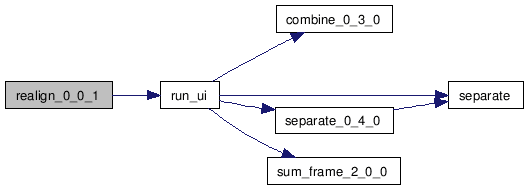
Here is the call graph for this function:
| run_ui | ( | defs, | ||
| modality, | ||||
| unwarp | ||||
| ) |
Within Mode Image Realignment
Modified for Turku PET Centre
version 0.0.1,26-04-2007,Harri Merisaari added reference frame selection
___________________________________________________________________________
This routine realigns a time-series of images acquired from the same subject
using a least squares approach and a 6 parameter (rigid body) spatial
transformation. The first image in the list specified by the user is used
as a reference to which all subsequent scans are realigned. The reference
scan does not have to the the first chronologically and it may be wise to
chose a 'representative scan' in this role.
For fMRI data an additional adjustment is made to the data that removes
a tiny amount of the movement-related confounds of these effects.
However, it may be preferable to include the functions of the estimated
movement parameters as confounds in the statistics part.
Uses
Primarily to remove movement artefact in fMRI and PET time-series (or more
generally longitudinal studies)
Inputs
A series of *.img conforming to SPM data format (see 'Data Format'). The
relative displacement of the images should be small with respect to their
resolution. This is usually easy to ensure for functional images (e.g.
fMRI, PET SPECT).
Outputs
The parameter estimation part writes out ".mat" files for each of the
input images. The part of the routine that writes the resliced images
uses information in these ".mat" files and writes the realigned *.img
files to the same subdirectory prefixed with an 'r' (i.e. r*.img). The
details of the transformation are displayed in the results window as
plots of translation and rotation.
A set of realignment parameters are saved for each session, named:
realignment_params_*.txt.
__________________________________________________________________________
Refs:
Friston KJ, Ashburner J, Frith CD, Poline J-B, Heather JD & Frackowiak
RSJ (1995) Spatial registration and normalization of images Hum. Brain
Map. 2:165-189
Friston KJ, Williams SR, Howard R Frackowiak RSJ and Turner R (1995)
Movement-related effect in fMRI time-series. Mag. Res. Med. 35:346-355
W. F. Eddy, M. Fitzgerald and D. C. Noll (1996) Improved Image
Registration by Using Fourier Interpolation. Mag. Res. Med. 36(6):923-931
R. W. Cox and A. Jesmanowicz (1999) Real-Time 3D Image Registration
for Functional MRI. Submitted to MRM (April 1999) and avaliable from:
http://varda.biophysics.mcw.edu/~cox/index.html.
_______________________________________________________________________
In addition to realigning (transforming the images according to a rigid
body model) the time series there is the option of modelling the residual
movement related variance in an EPI (fMRI) time series that can be
explained by a model for suceptibility-by-movement interactions. This
is given by the "Realign & Unwarp" option.
Susceptibility artefacts in EPI time series is a consequence of the
"field disturbances" caused by the presence of an object in the field.
Susceptibility is a property of a material, and can be thought of as
the "resistance" put up by that material against being magnetised.
At the interface between materials with different susceptibility
rather severe field disturbancies will ensue. I.e. the field is
no longer nice and homogenous. Since varying field strenght (gradients)
is used to encode position in MRI, these disturbances cause spatial
misplacement of RF signal, i.e. geometric distortions. Because of
the low bandwidth in the phase encode direction these distortions
will be appreciable mainly in that direction (typically the Ant-Post
direction). The distortions are noticable mainly near air-tissue
interfaces inside the scull, i.e. near the sinuses and the auditory
canals.
In these areas in particular the observed image is a severly warped
version of reality, much like a funny mirror at a fair ground. When
one moves in front of such a mirror ones image will distort in
different ways and ones head may change from very elongated to
seriously flattened. If we were to take digital snapshots of the
reflection at these different positions it is rather obvious that
realignment alone will not suffice to bring them into a common space.
The situation is similar with EPI images, and an image collected
for a given subject position will not be identical to that collected
at another. We call this effect suscebtibility-by-movement interaction.
The "Unwarp" toolbox is predicated on the assumption that the
suscebtibility-by-movement interaction is responsible for a sizeable
part of residual movement related variance.
Assume that we know how the deformations change when the subject changes
position (i.e. we know the derivatives of the deformations with respect
to subject position). That means that for a given time series and a
given set of subject movements we should be able to predict the "shape
changes" in the object and the ensuing variance in the time series.
It also means that, in principle, we should be able to formulate the
inverse problem, i.e. given the observed variance (after realignment)
and known (estimated) movements we should be able to estimate how
deformations change with subject movement.
We have made an attempt at formulating such an inverse model, and at
solving for the "derivative fields". A deformation field can be thought
of as little vectors at each position in space showing how that particular
location has been deflected. A "derivative field" is then the rate of
change of those vectors with respect to subject movement. Given these
"derivative fields" we should be able to remove the variance caused by
the suscebtibility-by-movement interaction. Since the underlying model
is so restricted we would also expect experimentally induced variance
to be preserved.
Refs
Background reading:
Friston KJ, Williams SR, Howard R, Frackowiak RSJ and Turner R (1995)
Movement-related effect in fMRI time-series. Mag. Res. Med. 35:346-355
Jezzard P and Balaban RS (1995) Correction for geometric distortions
in echoplanar images from B0 field variations. Magn Reson Med 34:65-73
Wu DH, Lewin JS and Duerk JL (1997) Inadequacy of motion correction
algorithms in functional MRI: Role of susceptibility-induced artefacts.
J Magn Reson Imag 7:365-370
About this particular method:
Andersson JLR, Hutton C, Ashburner J, Turner R, Friston K (2001)
Modelling geometric deformations in EPI time series. NeuroImage
13:903-919. doi:10.1006/nimg.2001.0746
_______________________________________________________________________
The Prompts Explained
_______________________________________________________________________
'Number of subjects'
Enter the number of subjects you wish to realign.
For fMRI, it will ask you the number of sessions for each subject.
In the coregistration step, the sessions are first realigned to
each other, by aligning the first scan from each session to the
first scan of the first session. Then the images within each session
are aligned to the first image of the session.
The parameter estimation is performed this way because it is assumed
(rightly or not) that there may be systematic differences
in the images between sessions.
The adjustment step (correcting for resampling artifacts) is also
performed completely independantly between each of the fMRI sessions.
'Images, subject # ..'
Select the scans you wish to realign. All operations are relative
to the first image selected.
......... Note that not all of the following prompts may be used: .........
'Which option?'
'Coregister only'
Only determine the parameters required to transform each of the
images 2..n to the same space as image 1.
The determined parameters for image XXXX.img are saved in the
file XXXX.mat. This is a Matlab file, containing the matrix 'M'.
The location of an image voxel (in mm) can be determined by
computing M(1:3,:)*[xcoord ycoord zcoord 1].
Note that if the coregistration is performed more than once on
the unresliced data, the starting estimates are obtained from
parameters stored in the '.mat' files.
Note that for PET, the coregistration is a two step process.
First of all, the images are all realigned to the first in
the series. A mean of these realigned images is created, and
a second pass realignment is performed to realign all the
images to the mean. Finally, the parameters are corrected
for any differences estimated by registering the first image in
the series to the mean image.
'Reslice Only'
Reslice the specified images according to the contents of the
previously determined parameters. The images are resliced to be
in the same space as the first one selected. For fMRI, this is
the first image of the first session.
'Coregister & Reslice'
Combine the above two steps together.
Options for reference image:
'Select reference frame(s)'
'1st frame (dafault)'
This uses 1st frame as reference image
'Select reference frame numbers'
This uses user selected frames from input for creating reference images
'Select reference frame image'
This uses user selected image for reference image
Options for reslicing:
'Create what?'
'All Images (1..n)'
This reslices all the images - including the first image selected
- reference frame will stay it soriginal position
'Images 2..n'
Reslices images 2..n only. Useful for if you wish to reslice
(for example) a PET image to fit a structural MRI, without
creating a second identical MRI volume.
'All Images + Mean Image'
In addition to reslicing the images, it also creates a mean of the
resliced image.
'Mean Image Only'
Creates the mean image only.
_______________________________________________________________________
Defaults Options
_______________________________________________________________________
'Registration Quality?'
Quality versus speed trade-off. Highest quality (1) gives most
precise results, whereas lower qualities gives faster realignment.
The idea is that some voxels contribute little to the estimation of
the realignment parameters. This parameter is involved in selecting
the number of voxels that are used.
[defaults.realign.estimate.quality]
'Allow weighting of reference image?'
Give the option of providing a weighting image to weight each voxel
of the reference image differently when estimating the realignment
parameters. The weights are proportional to the inverses of the
standard deviations.
For example, when there is a lot of extra-brain motion - e.g., during
speech, or when there are serious artifacts in a particular region of
the images.
[defaults.realign.estimate.weight]
'Reslice interpolation Method?'
The method by which the images are sampled when being written in a
different space.
'Nearest Neighbour'
- Fastest, but not normally recommended.
'Bilinear Interpolation'
- OK for PET, or realigned fMRI.
'B-spline Interpolation'
- Better quality (but slower) interpolation, especially
with higher degree splines. Don't use B-splines when
there is any region of NaN or Inf in the images.
'Fourier space Interpolation'
- Rigid body rotations are executed as a series of shears,
which are performed in Fourier space (Eddy et. al. 1996).
Unfortunately, this method can only be applied to images
with cubic voxels (since zooms can not be done by
convolution in Fourier space).
[defaults.realign.write.interp]
These are typically:
'No wrapping' - for PET or images that have already
been spatially transformed.
'Wrap in Y' - for (un-resliced) MRI where phase encoding
is in the Y direction (voxel space).
[defaults.realign.write.wrap]
'Mask images?'
Because of subject motion, different images are likely to have different
patterns of zeros from where it was not possible to sample data.
With masking enabled, the program searches through the whole time series
looking for voxels which need to be sampled from outside the original
images. Where this occurs, that voxel is set to zero for the whole set
of images (unless the image format can represent NaN, in which case
NaNs are used where possible). This is in order to avoid artifactual
movement-related variance the realigned images.
[defaults.realign.write.mask]
Other Defaults are useful for making spm_realign_ui.m more flexible:
[defaults.realign.estimate.interp] - interpolation method for parameter
estimation.
[defaults.realign.estimate.wrap] - wrapping used for parameter estimation.
This should probably also influence the way that smoothing is done, but
the smoothing code has not yet been modified to include wrapping.
__________________________________________________________________________
The `.mat' files.
This simply contains a 4x4 affine transformation matrix in a variable `M'.
These files are normally generated by the `realignment' and
`coregistration' modules. What these matrixes contain is a mapping from
the voxel coordinates (x0,y0,z0) (where the first voxel is at coordinate
(1,1,1)), to coordinates in millimeters (x1,y1,z1). By default, the
the new coordinate system is derived from the `origin' and `vox' fields
of the image header.
x1 = M(1,1)*x0 + M(1,2)*y0 + M(1,3)*z0 + M(1,4)
y1 = M(2,1)*x0 + M(2,2)*y0 + M(2,3)*z0 + M(2,4)
z1 = M(3,1)*x0 + M(3,2)*y0 + M(3,3)*z0 + M(3,4)
Assuming that image1 has a transformation matrix M1, and image2 has a
transformation matrix M2, the mapping from image1 to image2 is: M2\M1
(ie. from the coordinate system of image1 into millimeters, followed
by a mapping from millimeters into the space of image2).
These `.mat' files allow several realignment or coregistration steps to be
combined into a single operation (without the necessity of resampling the
images several times). The `.mat' files are also used by the spatial
normalisation module.
__________________________________________________________________________
The *uw.mat file.
The *uw.mat file contains information about input to the Unwarp module
(i.e. how it was run) and about the result. It contains all the information
needed to unwarp the appurtenant time-series, and to assess exactly how the
estimation was done.
__________________________________________________________________________
@(#)spm_realign_ui.m 2.13 John Ashburner - with input from Oliver Josephs 03/01/24
and Jesper Andersson
Modification for Turku PET Centre, Harri Merisaari
version 0.0.1,Harri Merisaari, added options for reference image creation
Copyright (c) 2007 by Turku PET Centre
| defs | ||
| modality | ||
| unwarp |
Here is the call graph for this function:
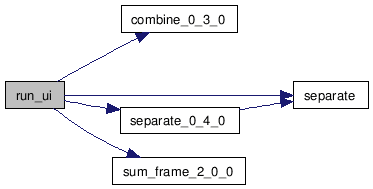
Here is the caller graph for this function:

1.5.2